Updated August 18th, 2026
Understanding the CLOUD Act: Data Sovereignty, Privacy, and Secure File Sharing
Cloud services make collaboration and cross-border data storage easier, but they raise a harder question: when data sits in the cloud, which country’s laws can reach it? For organizations handling sensitive information, that question affects privacy, compliance, and control. For IT, security, compliance, and legal leaders, the CLOUD Act is central to that discussion because it connects provider jurisdiction with data access, data sovereignty, and secure file sharing. Understanding that connection can guide decisions about where data is stored, and which providers organizations trust.
What Is the CLOUD Act?
The Clarifying Lawful Overseas Use of Data (CLOUD Act) is a U.S. law enacted in 2018 that addresses how law enforcement can obtain electronic data during criminal investigations. It can require providers under U.S. jurisdiction to produce data covered by a lawful order even when stored abroad. The Congress.gov text of S.2383 provides the legislative text.
The US CLOUD Act responded to legal uncertainty over cross-border data access. It clarified that a provider’s obligations can extend to data in its possession, custody, or control even when held overseas, so physical storage location does not always tell the full legal story.
The CLOUD Act also allows providers to ask a court to modify or quash certain legal demands for communications content when disclosure would create a material risk of violating the laws of a qualifying foreign government covered by a CLOUD Act executive agreement, subject to the Act’s other statutory conditions. Even with that safeguard, data may sit in one country while the service provider answers to another legal system.
Why the CLOUD Act Matters to Organizations
This turns the CLOUD Act into a practical cloud-security issue. Regulated organizations need to know both where data is stored and which jurisdiction can compel a provider to disclose it, because that can affect privacy risk, contractual obligations, compliance planning, and cloud architecture.
AWS, Microsoft Azure, and Google Cloud are operated by U.S.-based companies and together account for 63% of worldwide enterprise spending on cloud infrastructure services. That concentration makes provider jurisdiction a mainstream enterprise concern. For organizations handling regulated or sensitive data, CLOUD Act considerations can therefore affect a large share of the cloud infrastructure market by spend.
2025 Q1 – Global Cloud Infrastructure Services Market – Provider Comparison
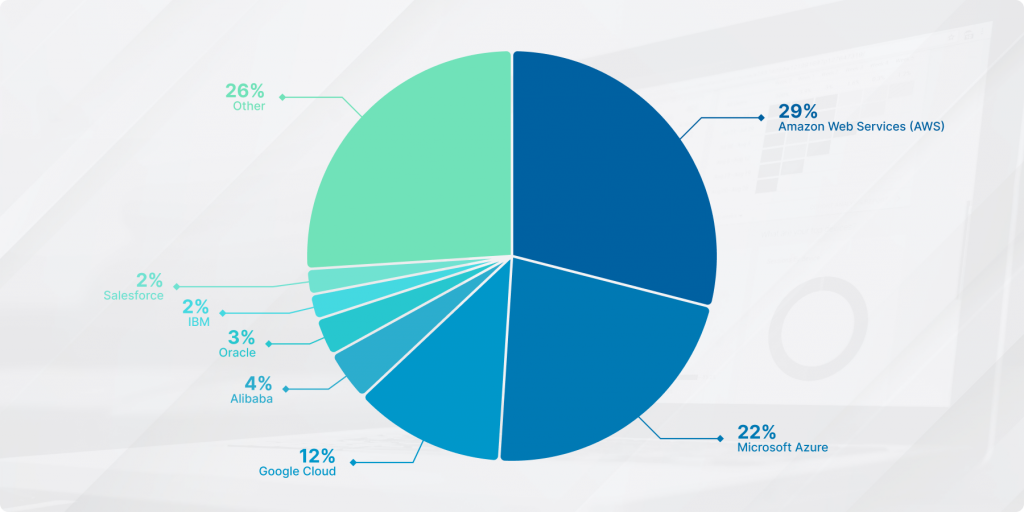
“Combined, AWS, Microsoft, and Google Cloud account for 63% of the total enterprise spending on cloud infrastructure services.”
“Cloud Computing Statistics”, Sci-Tech Today
A recent French Senate hearing on procurement and data sovereignty illustrates the issue. Senators asked a Microsoft executive whether Microsoft France could guarantee that French citizens’ data would remain outside the reach of U.S. legal demands. The executive affirmed the opposite – that French citizens data may very well be transmitted to United States authorities, even without explicit authorization from the French government.
“In other words, if the United States were to issue a legal request to Microsoft for the data of a French citizen hosted in the EU, Microsoft would comply regardless of French or EU law.
We can assume that this is irrespective of country, as France and the EU have some of the strictest data protection laws in the world and the U.S. law they are talking about is the United States CLOUD Act.”
—Alexander Rudolph, “Microsoft says U.S. law takes precedence over Canadian data sovereignty”, Digital Journal
That raises the practical question at the heart of data sovereignty: who can access your data, and under which legal authority?
The CLOUD Act and Data Sovereignty
Data sovereignty refers to the principle that data is governed by the laws and regulatory requirements of the jurisdiction in which it is stored or processed. The CLOUD Act shows why physical storage location may not tell the full legal story.
If a service provider falls under U.S. jurisdiction, U.S. legal obligations can remain relevant when data sits abroad. For organizations that require strict control over data location, access, and legal exposure, a European server does not automatically remove U.S. jurisdictional considerations when a U.S.-based provider controls the service.
A data sovereignty strategy therefore needs to consider both where data lives and who controls the infrastructure. FileCloud discusses these considerations in Data Sovereignty Compliance Made Easy with FileCloud.
Intersection With Global Data Privacy Legislation
The CLOUD Act also sits alongside privacy laws such as the General Data Protection Regulation (GDPR), which governs personal-data processing and sets specific requirements for transfers to third countries or international organisations. This can create difficult questions when a provider faces legal duties in more than one jurisdiction.
Privacy officers, legal teams, and compliance leaders must therefore assess more than security controls: they also need to understand the provider’s legal footprint, data location, access terms, and process for government requests.
The CLOUD Act’s statutory mechanism addresses certain conflicts with the laws of qualifying foreign governments, but cross-border requests can still involve legal uncertainty. For organizations subject to GDPR or similar data privacy legislation, that makes careful vendor and architecture reviews essential.
Impact on Regulated Industries
These questions carry extra weight in healthcare, financial services, government, education, and legal services, where organizations often hold sensitive or protected information under strict data-protection rules. Misunderstanding jurisdiction can create compliance, legal, and reputational risk.
The CLOUD Act adds another factor to that risk assessment: who can access data, how providers respond to lawful demands, whether audit records are available, and whether deployment models support local or sector-specific requirements. Clear data ownership and governance controls help teams defend those decisions.
Secure File Sharing in a CLOUD Act Environment
These questions carry extra weight in healthcare, financial services, government, education, and legal services, where organizations often hold sensitive or protected information under strict data-protection rules. Misunderstanding jurisdiction can create compliance, legal, and reputational risk.
The CLOUD Act adds another factor to that risk assessment: who can access data, how providers respond to lawful demands, whether audit records are available, and whether deployment models support local or sector-specific requirements. Clear data ownership and governance controls help teams defend those decisions.
Evaluating Cloud and File Sharing Architectures
As organizations become more aware of the CLOUD Act, many start looking again at their cloud and file-sharing architecture. Public cloud services offer scale and convenience, but they can also create jurisdictional dependencies that deserve careful review.
Private cloud, self-hosted, and region-specific deployments can offer another path. Depending on the organization’s needs, these models may provide tighter control over storage location, infrastructure, access policies, and administration. The right choice will depend on regulatory duties, technical resources, risk tolerance, and operational goals.
For IT and security leaders, the useful question is not simply “cloud or no cloud?” It is: which deployment model gives us the level of control, security, and legal clarity our data requires?
Sovereign File Sharing with FileCloud

FileCloud helps organizations address these concerns through secure file sharing, data sovereignty controls, and flexible deployment options. Organizations can use private cloud and self-hosted deployments to keep greater control over their data and infrastructure rather than relying entirely on a third-party public cloud environment.
FileCloud also combines that deployment flexibility with data security and administrative controls designed for compliance-focused environments. This gives IT, security, and compliance teams more choice over where data resides, how users access it, and how the organization governs sensitive information.
For organizations assessing the US CLOUD Act, the goal is not simply storage location but a file-sharing architecture that supports data ownership, security, governance, and wider compliance requirements.
Want to explore how FileCloud can support secure file sharing and data sovereignty?
Sign up for a free trial or schedule a demo!
Frequently Asked Questions
What is the CLOUD Act, and what does it do?
The CLOUD Act is short for the Clarifying Lawful Overseas Use of Data Act. This US law was enacted in 2018. Under the Act, certain providers of electronic communication services or remote computing services that are subject to US jurisdiction must comply with valid legal process. The rule applies to data in their possession, custody, or control, even if the data is stored abroad. The Act also creates a framework for executive agreements on cross-border access to electronic evidence.
Who does the CLOUD Act apply to?
The rule applies to providers of electronic communication services or remote computing services that are subject to US jurisdiction. The requested data must also be within the provider’s possession, custody, or control. A business may therefore be affected when it stores data with such a provider. Whether a firm is subject to US jurisdiction depends on the facts of the case.
Can the CLOUD Act apply to data stored outside the United States?
Yes. Through valid legal process, a covered provider may have to preserve, back up, or disclose electronic communications, records, or other responsive information within its possession, custody, or control. This rule applies even when the data is stored outside the United States. It does not give authorities automatic access to all data stored abroad.
Can encrypted cloud data still be subject to a CLOUD Act order?
Potentially. Encryption does not automatically place data beyond the reach of valid legal process. However, the CLOUD Act is encryption-neutral. It does not require providers to be able to decrypt data, and it creates no new power to compel decryption. The result may depend on the provider’s technical ability, the encryption keys it controls, and other applicable law.
How can FileCloud support secure file sharing and data sovereignty in light of the CLOUD Act?
FileCloud offers on-premises, hybrid, and region-specific deployment options. These choices can help a team decide where its data is kept and who can access it. FileCloud also provides end-to-end encryption, two-factor authentication, and role-based access controls. Together, these tools can support secure file sharing and data sovereignty in light of the CLOUD Act. They do not, however, guarantee legal compliance or remove any CLOUD Act obligations that may apply.

By Holly Martin