Self-Hosted File Sharing and Sync

Run FileCloud on your own servers for full control over where enterprise files live, who can reach them, and how they are shared. Free for up to 5 users.

Get Free Trial →
Client Logo
Client Logo
Client Logo
Client Logo
Client Logo

Own Your File Infrastructure

Deploy On Your Terms

Install on Windows Server, Linux, Docker or a cloud instance you control. Store files on local disk, existing network shares, or S3-compatible object storage. Your data sits on infrastructure you own or lease directly.

Keep Your Existing File Server

Layer remote access and secure sharing over the Windows file server you already run, preserving NTFS permissions on network folders and Active Directory identity. No migration required.

Share Without Losing Control

Password-protected and expiring links, download limits, granular permissions, full audit logging, DLP and content classification across everything your users share internally and externally.

Gartner Per Insights Logo 2018
Gartner Per Insights Logo 2019
Gartner Per Insights Logo 2020
Gartner Per Insights Logo 2021
Gartner Per Insights Logo 2022

FileCloud has received the Gartner Peer Insights Customers’ Choice Distinction for the fifth consecutive time!

92% of our customers would recommend us to a friend.

Rating Stars Image 4.6

What Is Self-Hosted File Sharing?

Self-hosted file sharing means running the software that stores, syncs, and shares your files on hardware you control, rather than paying a provider to run it for you.

With Dropbox, Google Drive, or SharePoint, your files live on someone else’s servers and you pay per user every month. Self-host and you install the software on a server, VM, or cloud instance you rent. The files sit on storage you own. You handle updates and backups. Nobody else holds a copy.

Four practical differences:

  • Where the data sits. You choose the machine and the jurisdiction.
  • Who can access it. No provider staff, no third-party subpoena, no dependency on another company’s security posture.
  • What it costs as you grow. Licensed per server or in user bands, not per seat per month.
  • What happens if the provider changes. Price increases and feature removals do not force a migration.

Self-hosting is closely related to private cloud storage. The difference is one of focus: private cloud storage is about where data physically sits, while self-hosted file sharing is about how people access, share, and govern it.

FileCloud Server gives organizations a complete self-hosted file sharing platform on infrastructure they control, combining flexible storage, secure sharing and sync, granular permissions, auditing, and compliance tooling.

How Self-Hosted File Sharing Works

The infrastructure determines where your files live. The platform determines how they are accessed, shared, protected, and governed. FileCloud provides the second layer across whatever storage you already have.

Self-Hosted Deployment Options

Option Description
On-premises server Windows Server or Linux inside your own environment, behind your firewall
Private or public cloud Your own instance on AWS, Azure, Oracle Cloud, or any IaaS provider
Docker Containerized deployment for teams already running container infrastructure
Hybrid Existing file server for fast LAN access, cloud instance for remote users, and offsite redundancy

Storage can sit on local disk, existing network shares, Amazon S3, Azure Blob, or other S3-compatible object storage, and these can be mixed within one deployment.

How Self-Hosted File Sharing Compares

Self-Hosted vs. Cloud Services

Self-Hosted Cloud Service
Data location You choose Provider’s regions
Cost model License plus your infrastructure Per user, per month, indefinitely
Setup and maintenance Yours Theirs
Customization Extensive, including white labeling Limited to what is offered
Compliance control Direct Dependent on provider certifications
Scaling Add hardware Add seats

Both models can be secure. Below about ten users with no IT resources, a hosted service may be a better fit. The economics shift as user numbers grow, or where compliance makes a shared cloud unworkable.

FileCloud vs. Other Self-Hosted Platforms

FileCloud Nextcloud ownCloud Seafile
Native Windows Server deployment Yes No No No
Existing file server integration Yes Yes Yes Limited
DLP and classification Built in Available through workflow/apps Available Limited
Compliance and audit tooling Built in Available Available Available in Pro
Free self-hosted option 5 full users + 10 external users Yes Yes Yes
Commercial support Yes Yes Yes Yes

Self-hosted platforms differ most in deployment support, existing storage integration, security and compliance tooling, and commercial support. FileCloud is designed to combine self-hosted deployment with enterprise administration, governance, and support.

See how FileCloud compares to ownCloud and Nextcloud, or read our breakdown as a self-hosted Dropbox alternative.

Data Security

Self-hosting puts security in your hands, so the platform needs to give you the tools to exercise it. FileCloud includes:

  • Encryption options: customer managed encryption keys, AES 128- or 256-bit encryption, SSL/TLS tunnels, and FIPS 140-2 encryption.
  • Data governance and visibility: role-based access controls, comprehensive audit logs and reporting, metadata, OCR/pattern search, data leak prevention (DLP), retention policies, and Digital Rights Management (DRM).
  • Ecosystem security: antivirus scanning, ransomware protection, two-factor authentication, endpoint and automated backups, and Active Directory/LDAP integration.

Learn more by reading the FileCloud Security FAQs white paper.

FileCloud Security Best Practices white paper

Secure File Sharing

Users can leverage FileCloud’s powerful file sharing features to collaborate on files remotely.

  • Set shares as private (user/group) or public (link/QR code), with additional options to share as view-only, limit downloads, set expiration dates, or set a password.
  • Collaborate on files in real time, with Microsoft Integrations and Desktop Edit in FileCloud.
  • Recover deleted files from the recycle bin and restore previous versions with unlimited file versioning.
  • Lock files to prevent overwriting (and automate file locking/unlocking with FileCloud for Office).
  • Extend secure file sharing to clients, vendors, and suppliers with FileCloud’s unlimited external accounts (no additional license cost).

FileCloud's Sharing Options Screenshot

Sharing Outside Your Organization

External sharing is where most self-hosted platforms fall short and where most data leaves organizations. FileCloud shares can be private or public, view-only, password-protected, download-limited, or time-limited, and every share is logged. Client and partner accounts are unlimited at no additional license cost.

You can also run the platform under your own brand: custom logos, login images, email templates, your own CSS, and your own domain.
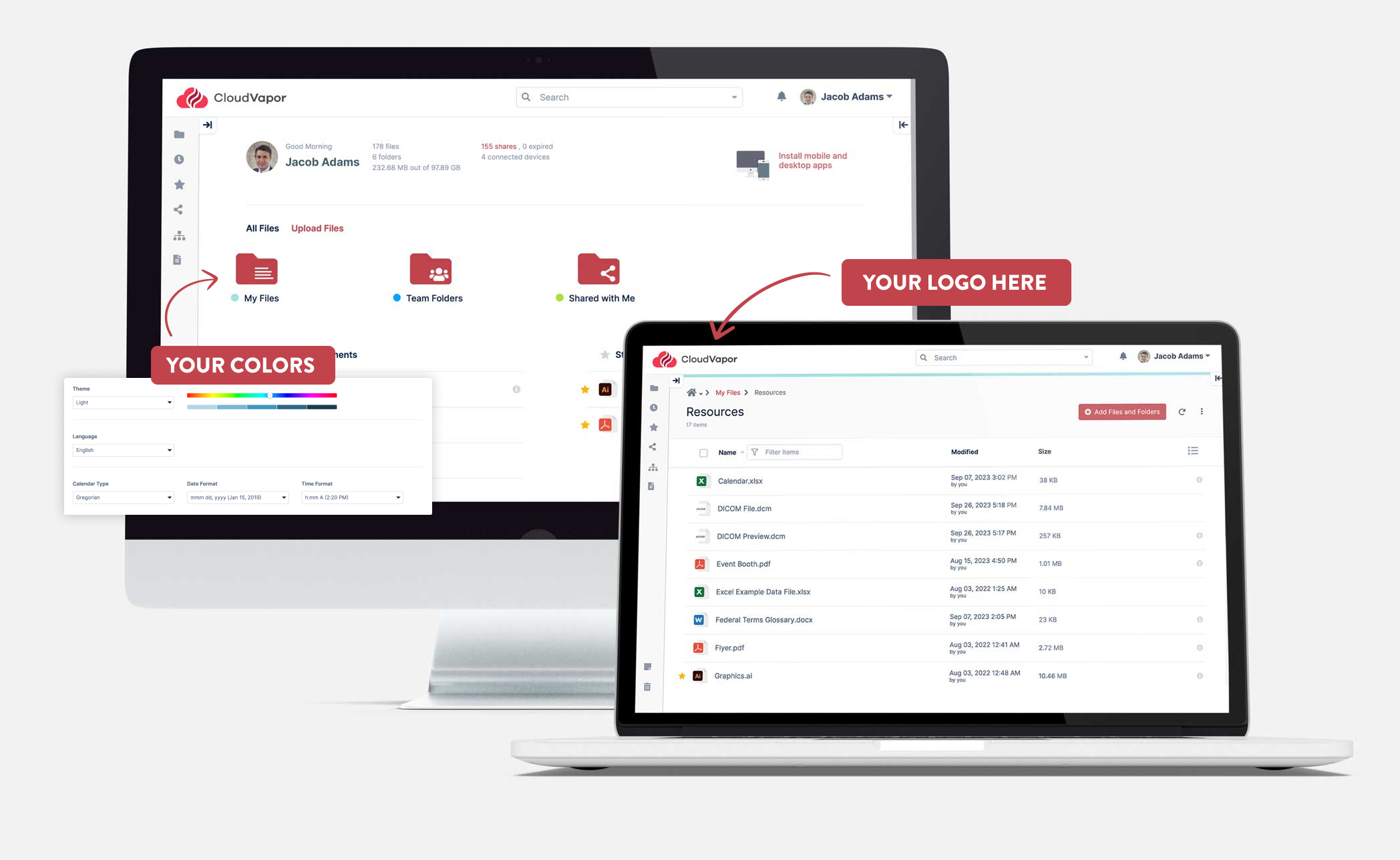
FileCloud customization options

How to Evaluate a Self-Hosted File Sharing Platform

Self-hosted options range from a single-purpose upload script to a full collaboration platform. Look for one that can:

● Run on your environment: Windows Server, Linux, Docker or cloud
● Work with existing storage and network shares, preserving NTFS permissions
● Integrate with Active Directory, LDAP or SSO
● Provide desktop sync, a virtual drive and mobile apps
● Control external sharing with passwords, expiry dates and download limits
● Encrypt in transit and at rest, with multi-factor authentication and audit logging
● Support retention, classification and DLP where content is regulated
● Offer central administration, device management and supported upgrades

FileCloud Server brings these together in a single self-hosted platform, with native Windows and Linux support, existing file server integration, unlimited external accounts, and compliance tooling built in rather than assembled from plugins.

Who Uses Self-Hosted File Sharing?

Scenario Why They Self-Host What Supports It
Replacing a legacy file server Remote access without moving data anywhere ServerSync for existing Windows file servers, NTFS support, VPN-less access
Regulated industries Providing evidence of where data sits and who accessed it Audit logs, DLP, classification, regulatory compliance
Outgrowing per-seat pricing Cost at scale, including replacing SharePoint Server licensing, unlimited external accounts
Home labs and personal use Control and privacy Build your own cloud storage at home with Community Edition

Try Self-Hosted File Sharing Free

FileCloud Community Edition is free for up to 5 full users and 10 external accounts. It is the complete server, not a feature-limited trial, and runs on Windows, Linux, Docker, or any cloud instance.

The license runs for a year and can be renewed from the customer portal at no cost, as often as you need, so Community Edition stays free for as long as you use it.

It includes Team Folders, granular permissions, password-protected and time-limited shares, unlimited file sizes, versioning, desktop sync, FileCloud Drive, and mobile apps.

You will need a Windows or Linux server with storage, a valid SSL certificate, an appropriate network configuration, and basic system administration knowledge.

Running a home server rather than a business? FileCloud Community Edition for personal use covers what is included and how to get started.

Download Community Edition free

Need more than 5 users? FileCloud Server adds unlimited users, single sign-on, custom branding, antivirus scanning, DLP, and supported upgrades.

Frequently Asked Questions (FAQs)

What is a self-hosted file sharing solution?

A self-hosted file sharing solution is software that you install and run on your own servers, either on-premises or within your private cloud environment. This gives you complete control over your data, security, and infrastructure, unlike a public cloud service where a third party manages the servers.

What do I need to self-host a file sharing server?

A Windows or Linux server, VM or cloud instance with enough storage, a domain name, a valid SSL certificate, network configuration allowing external access, and basic system administration knowledge. A modest VM is enough for a small deployment.

Is there a free self-hosted file sharing option?

Yes. FileCloud Community Edition is free for up to 5 users and 10 external accounts. Nextcloud, ownCloud and Seafile also offer free community versions. The differences are platform support, administration features, and whether compliance tooling is built in or added through plugins.

What happens to Community Edition after the first year?

The license runs for one year. At the end of it, log in to the customer portal and download the license again. This issues a new license and resets the start date. There is no limit on how often you can do this, so Community Edition can be extended for as long as you need it.

Can I use FileCloud with my existing servers?

Yes. FileCloud Server can be deployed on Windows servers, Linux servers, or within your private cloud on platforms like AWS or Microsoft Azure. It can also sit on top of existing Windows network shares and preserve NTFS permissions, so you add remote access and secure sharing to data already in place rather than migrating it.

What is the difference between self-hosted and on-premises file sharing?

On-premises means the servers are physically in your building. Self-hosted means you control the software and data, which includes a cloud instance you rent. All on-premises deployments are self-hosted; not all self-hosted deployments are on-premises.

Worldwide

FileCloud
CodeLathe Technologies Inc.
dba FileCloud
125 Park Avenue FL 25
New York, NY 10017-5550

Europe

FileCloud Technologies Limited
Ducart Suite,
Castletroy Park Commercial Centre, Castletroy,
Limerick, Ireland


Copyright © FileCloud. All Rights Reserved.
You selected

FileCloud Server

A self-hosted FileCloud trial requires:
  • a Windows or Linux server with storage
  • a valid SSL certificate
  • an appropriate network configuration
  • system administration knowledge

If you prefer to evaluate FileCloud without installation, we recommend using our Online Trial.