Sending large files to China is not simply a matter of finding a service that accepts a large upload. For enterprises collaborating across borders, the bigger challenge is transferring business-critical content reliably while maintaining security, governance, and administrative control.
The files themselves can also be complex. An architecture, engineering, and construction (AEC) firm might exchange BIM models, CAD drawings, renderings, and project archives with contractors or suppliers. Healthcare and life sciences organizations may collaborate around medical images, research datasets, or laboratory documentation. Universities and research institutions increasingly work with large scientific datasets, imaging files, simulation outputs, and other research materials.
When these workflows involve teams, partners, or infrastructure in China, large file size becomes only one part of the problem.
Why Is It Difficult to Send Large Files to China?
Cross-border internet conditions can make transferring large files to and from China less predictable than moving the same data within a single region. China’s internet filtering system, commonly called the Great Firewall of China, affects access to many foreign websites and online services, while routing and network conditions can contribute to slower or interrupted cross-border connections.
For an enterprise transferring a multi-gigabyte BIM model, DICOM imaging dataset, research archive, or batch of high-resolution design files, an interrupted connection can translate directly into lost time. If the transfer platform cannot resume an upload, users may need to restart the entire process.
Organizations also need to think beyond performance. Sensitive files may contain intellectual property, regulated information, proprietary research, commercial plans, or confidential project data. IT teams need to determine who can access those files, whether recipients should be able to download or reshare them, how activity will be recorded, and whether the transfer raises data residency or cross-border governance considerations.
The result is a dual challenge: move large files effectively and retain control over them throughout the collaboration lifecycle.
Why Email, VPNs, and Traditional File Transfer May Not Be Enough
Email is often the first tool users reach for, but attachment limits quickly make it impractical for enterprise-scale files. Splitting a large design package or research dataset into compressed archives creates additional work, while emailed attachments create uncontrolled copies that can become difficult to update, revoke, or track.
Traditional FTP or similar file-transfer tools can move large volumes of data, but they may provide a limited collaboration experience. Enterprises often need more than a destination folder: users need controlled external sharing, current file versions, permissions, auditability, and security policies around the content itself.
VPNs address a different problem. They can provide remote connectivity to internal resources, but asking external partners or distributed teams to connect through a corporate VPN whenever they need a project file can introduce complexity and support overhead. Performance can also depend heavily on the organization’s network architecture.
Consumer cloud-transfer tools may be convenient for individual exchanges but are not necessarily designed around enterprise requirements such as centralized administration, DLP, data governance, detailed auditing, or controlled long-term collaboration.
For recurring cross-border workflows, organizations increasingly need a platform that treats large file transfer as part of a broader secure content collaboration strategy.
What Should an Enterprise Large File Transfer Solution Provide?
A modern enterprise platform for sending large files to and from China should combine transfer capabilities with security, governance, and administrative oversight.
Key capabilities include:
- Large file support: Accommodate BIM models, CAD files, medical imaging, datasets, video, archives, and other high-volume content.
- Resumable uploads: Continue an interrupted upload rather than restarting a multi-gigabyte transfer.
- Secure external sharing: Give contractors, research partners, suppliers, and other outside users controlled access to specific content.
- Encryption: Protect files while they are being transferred and while they are stored.
- Granular permissions: Control who can view, download, edit, upload, or reshare files.
- Data Leak Prevention (DLP): Apply policies to sensitive content before it is shared or downloaded.
- Data governance: Support classification, retention, auditing, and other controls throughout the information lifecycle.
- Detailed audit logs: Maintain visibility into uploads, downloads, sharing, access, and other file activity.
- Flexible deployment: Select an architecture that reflects the organization’s infrastructure, data residency, security, and operational requirements.
These capabilities become particularly important when cross-border file transfer is not a one-time event, but part of an ongoing enterprise workflow.
Resumable Uploads for Large Cross-Border Transfers
The larger the file, the more disruptive a dropped connection can become. Restarting a 50 GB engineering package, imaging archive, or scientific dataset after a network interruption can consume significant time and bandwidth.
Resumable uploads allow an interrupted transfer to continue from its previous progress once connectivity is restored. They do not eliminate cross-border latency or guarantee a particular transfer speed, but they can make large file workflows significantly more resilient when network conditions fluctuate.
Data Leak Prevention for Sensitive Files
Large files can also contain highly sensitive information. AEC teams may be sharing proprietary drawings or infrastructure documentation; healthcare organizations may need to control access to sensitive research or clinical information; universities may collaborate around unpublished research or valuable intellectual property.
Data Leak Protection gives administrators a way to apply policies to those workflows. DLP can help organizations identify sensitive content and restrict actions such as external sharing or downloading according to defined rules, reducing the risk that important information is exposed as collaboration expands across users, organizations, and borders.
Controlled External File Sharing
Many enterprise transfers to China involve people outside the organization: construction contractors, manufacturing partners, medical research collaborators, universities, suppliers, or consultants.
Instead of sending another uncontrolled file copy, secure external sharing allows the organization to provide access to centrally managed content. Administrators can apply permissions and sharing controls based on the needs of the project, while authorized external users receive access only to the files and folders they require.
This model also supports ongoing collaboration. When a BIM model, research dataset, specification, or project document changes, teams can continue working through the centralized environment rather than generating another chain of attachments and duplicate copies.
Data Governance Across the File Lifecycle
Secure file transfer should not end once a recipient successfully downloads a file. Enterprises also need to understand where information resides, how it is classified, who has interacted with it, and how long it should be retained.
Capabilities such as metadata, classification, retention policies, audit logs, and centralized administrative controls help organizations maintain visibility over shared information. This is particularly important for cross-border workflows that may involve data residency, privacy, intellectual property, or other regulatory considerations.
Technology does not replace an organization’s legal assessment of Chinese or other applicable cross-border data requirements, but governance controls can provide the technical foundation for implementing those policies.
How to Transfer Large Files to and from China with FileCloud
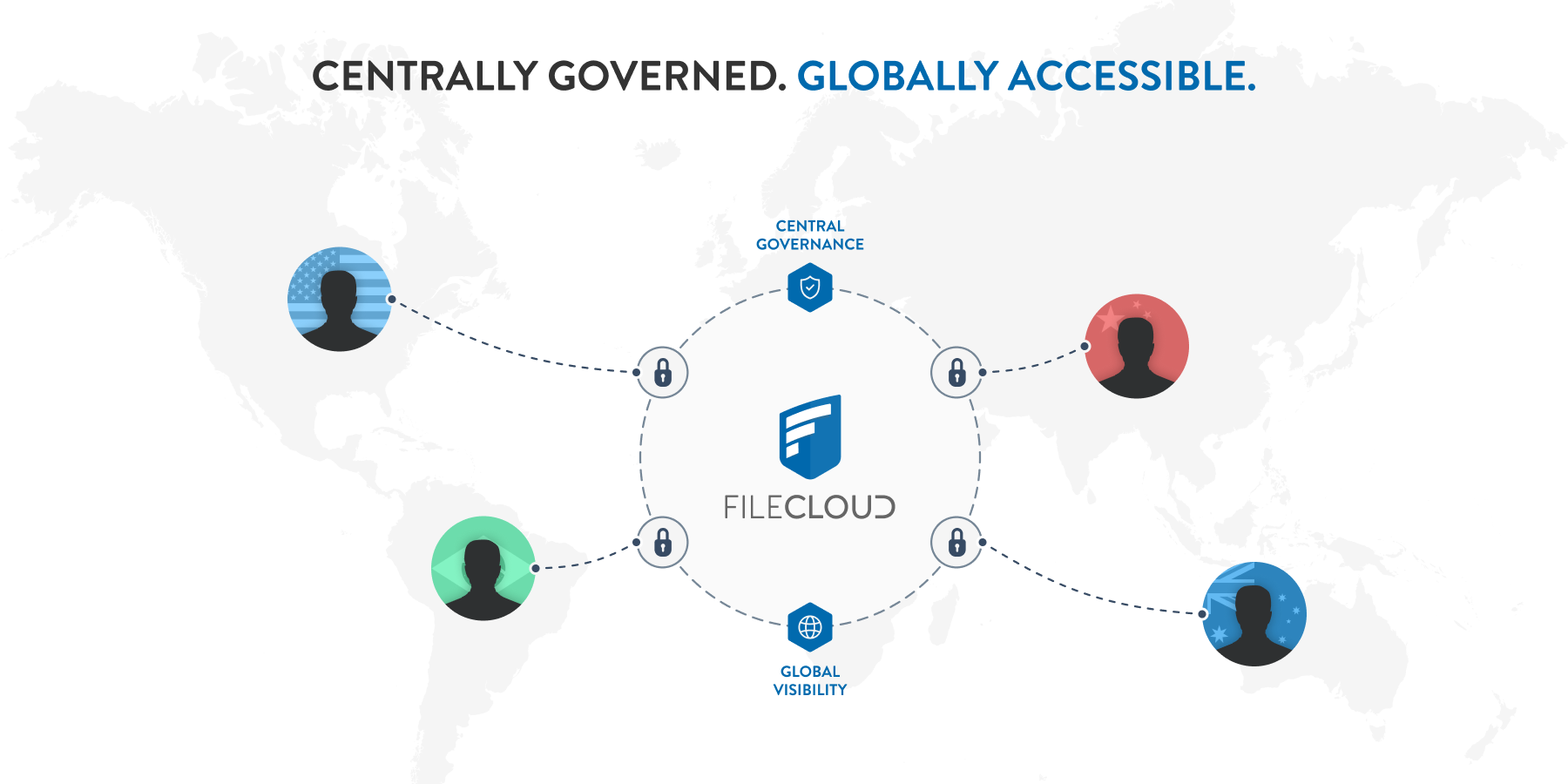
FileCloud brings large file transfer into an enterprise content collaboration environment, combining support for large and resumable uploads with encryption, granular permissions, DLP, governance, external sharing, and auditability.
A typical cross-border workflow can follow a straightforward process:
- Upload enterprise content to FileCloud. Teams can work with large project files, datasets, archives, design assets, and other business content. Resumable upload capabilities help reduce the impact of temporary connectivity interruptions.
- Provide access to the appropriate users. Employees can collaborate internally, while contractors, suppliers, research partners, or other external stakeholders can be given access to designated content.
- Apply sharing and security controls. Administrators can configure permissions and other access controls according to the sensitivity of the information and the recipient’s role.
- Apply DLP and governance policies. Sensitive information can be managed using DLP rules alongside classification, retention, and other governance capabilities.
- Track file activity. Detailed audit logs provide visibility into file access, sharing, uploads, downloads, and related user activity.
- Continue collaborating from a centralized environment. Instead of repeatedly distributing new copies, project teams can work with current versions of shared content through FileCloud.
For an AEC firm, that might mean securely exchanging updated BIM models and project drawings with overseas contractors. A healthcare or life sciences organization might use the same controlled environment for research files and large imaging datasets. Universities can provide research collaborators with managed access to datasets and project content without falling back on email attachments or unmanaged transfer services.
FileCloud also offers flexible deployment options, enabling organizations to design an architecture around their infrastructure, security, operational, and data residency requirements.
The objective is not simply to find a way to send one very large file. For enterprises operating across borders, the stronger approach is to establish a repeatable, secure, and governed environment for transferring and collaborating on business-critical information.
FileCloud should not be considered a mechanism for bypassing China’s internet restrictions, and transfer performance will still depend on factors such as hosting location, network routing, user location, and deployment architecture. Enterprises with important workflows in China should test representative users, locations, and file sizes as part of their evaluation.
Frequently Asked Questions
How can an enterprise send large files to China?
Enterprises should use a secure file-sharing platform that supports large and resumable uploads, controlled external sharing, encryption, permissions, DLP, and auditing. This provides greater control than relying on email attachments or one-time consumer transfer services.
Why can large file transfers to China be interrupted?
Cross-border connections can be affected by internet filtering, routing, server location, local network conditions, and file size. For large transfers, resumable upload capabilities can reduce the disruption caused by temporary connection failures.
How can organizations protect sensitive files shared with users in China?
Enterprises can combine encryption with granular permissions, authentication, DLP, controlled external sharing, governance policies, and audit logging. The appropriate controls depend on the organization’s security requirements and the sensitivity of the information.
Does FileCloud bypass the Great Firewall of China?
FileCloud should not be considered a tool for bypassing China’s internet controls. Accessibility and performance depend on the deployment architecture, server location, local and cross-border network conditions, and user location.
Are transfers to or from China subject to data regulations?
Potentially. Applicable requirements depend on factors including the data involved, where it originates, how it is processed, and the organizations participating in the transfer. Enterprises should assess applicable cross-border, privacy, and data governance requirements with their legal and compliance teams.

Product Marketing Manager