For years, organizations approached data protection primarily through the lens of data residency. If sensitive information remained stored within the European Union or another approved region, many assumed it was sufficiently protected from external access and jurisdictional risk.
Today, that assumption is changing.
Across Europe and other highly regulated markets, organizations are taking a broader approach to data sovereignty — one that extends beyond where data is physically stored to include who controls the infrastructure, which legal systems may apply, and whether organizations can maintain true operational authority over sensitive information.
This shift is reshaping how enterprises evaluate cloud collaboration and file sharing platforms. Increasingly, procurement teams, compliance leaders, and security stakeholders are asking not only where data resides, but also who controls administrative access, how governance policies are enforced, and whether sovereignty controls can be independently verified.
cAs organizations strengthen their data sovereignty strategies, many are discovering that regional hosting alone no longer fully addresses modern sovereignty requirements.
FileCloud helps organizations take a broader approach to data sovereignty by providing flexible deployment models, customer-controlled infrastructure options, and enterprise governance capabilities designed to support stronger control over sensitive data environments.
Data Residency vs. Data Sovereignty
Although the terms are often used interchangeably, data residency and data sovereignty represent two very different concepts.
Data residency refers to the geographic location where data is stored. For example, an organization may require that files, backups, or customer information remain within the EU. Residency focuses primarily on physical storage location.
Data sovereignty goes much further. It addresses which legal systems and governmental authorities may ultimately assert jurisdiction over that data — regardless of where the information physically resides.
An organization may store data in an EU-based data center, yet still face jurisdictional exposure if the cloud provider or parent company falls under foreign legal authority. This distinction is becoming increasingly important as governments and enterprises place greater scrutiny on cross-border data access, digital sovereignty initiatives, and long-term operational resilience.
As a result, organizations are beginning to recognize that data residency alone does not necessarily guarantee data sovereignty.
The Growing Shift Toward Data Sovereignty
The global conversation around data sovereignty has accelerated significantly in recent years. Rising geopolitical uncertainty, expanding compliance requirements, and growing concerns surrounding jurisdictional exposure are pushing organizations to reevaluate how they manage and govern sensitive information.
In Europe particularly, digital sovereignty has become a strategic priority across both public and private sectors. Organizations increasingly want greater visibility into how their data is managed, who controls the infrastructure supporting it, and whether critical systems remain dependent on providers operating under external legal frameworks.
This shift is also influencing enterprise procurement decisions. Security and compliance teams are no longer evaluating cloud platforms solely based on features or regional hosting availability. Increasingly, they are assessing whether providers can support broader sovereignty requirements tied to governance, operational control, and legal jurisdiction.
The question is no longer simply:
“Where is the data stored?”
Organizations are now also asking:
“Who ultimately controls the data?”
Why Organizations Need Provable Data Sovereignty
Another major market shift is the growing demand for provable data sovereignty.
Organizations are increasingly expected to demonstrate where sensitive data resides, who controls administrative access, how governance policies are enforced, and whether external entities may gain access through jurisdictional or operational pathways.
This is especially important for organizations operating in government, defense, financial services, healthcare, critical infrastructure, and other highly regulated industries where sovereignty concerns extend beyond compliance checklists into broader cybersecurity and operational risk management strategies.
As a result, many organizations are reevaluating traditional SaaS collaboration models and exploring deployment approaches that provide stronger operational control, including self-hosted environments, private cloud infrastructure, hybrid architectures, and customer-controlled storage models.
The goal goes beyond regional hosting. Even data sovereignty itself isn’t quite enough. Organizations working with sensitive information, subject to EU sovereignty laws, must also be able to demonstrate their authority over data, governance, and infrastructure.
How FileCloud Supports Data Sovereignty
As organizations prioritize enterprise data sovereignty, many are looking for collaboration platforms that provide greater flexibility and control over how sensitive information is stored, governed, and accessed.
Unlike platforms that rely primarily on shared SaaS infrastructure, FileCloud supports multiple deployment models designed to help organizations align their file sharing and collaboration environments with broader data sovereignty requirements. Organizations can deploy FileCloud on-premises, within private cloud environments, through hybrid architecture, or using regional infrastructure aligned with their operational and compliance requirements.
This flexibility allows organizations to maintain greater control over infrastructure, assert administrative authority, create governance policies, and implement data residency strategies while supporting broader digital sovereignty initiatives.
FileCloud also supports data sovereignty through enterprise-grade governance and security capabilities including granular access controls, exportable audit trails, encryption for data at rest and in transit, SSO and MFA integrations, customer-controlled storage, and Zero Trust File Sharing® capabilities designed to help organizations strengthen visibility and control over sensitive data environments.
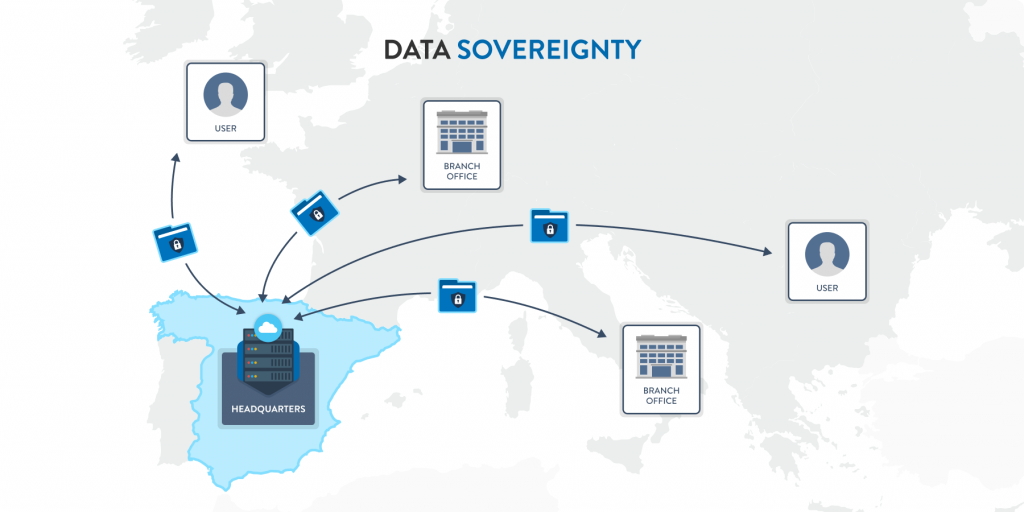
For organizations navigating growing jurisdictional scrutiny and evolving sovereignty requirements, maintaining control over data is becoming just as important as protecting it.
Data Sovereignty Requires More Than Geography
As regulatory expectations and digital sovereignty initiatives continue to evolve, organizations are recognizing that data residency alone no longer fully addresses modern enterprise risk and governance requirements.
True data sovereignty requires more than storing data in a specific region. It requires visibility, governance, operational control, and confidence in who ultimately controls access to sensitive information.

Content Marketing Strategist