Cloud Data Protection

Protect Sensitive Data Across Cloud and Hybrid Environments

GET FREE TRIAL
Client Logo
Client Logo
Client Logo
Client Logo
Client Logo

Cloud Data Protection Best Practices

Data Security

FileCloud helps organizations protect sensitive information at rest and in transit with encryption, granular access controls, secure sharing, and data governance. Retention policies and administrative controls help organizations manage how data is stored, accessed, shared, and retained.

Regulatory Compliance

FileCloud provides security and governance capabilities that support requirements including HIPAA, FINRA, GDPR, ITAR, CMMC, and FIPS 140-3 on supported deployments. FileCloud is also available in a FedRAMP Certified, Class D (High) environment for organizations with applicable U.S. federal cloud requirements.

Efficient Content Management

Smart Content Classification and metadata help organizations identify, organize, and manage sensitive information at scale. Administrators can locate content containing PII, PHI, PCI data, and other sensitive information and apply appropriate governance, DLP, and retention policies.

Gartner Per Insights Logo 2018
Gartner Per Insights Logo 2019
Gartner Per Insights Logo 2020
Gartner Per Insights Logo 2021
Gartner Per Insights Logo 2022

FileCloud has received the Gartner Peer Insights Customers’ Choice Distinction for the fifth consecutive time!

92% of our customers would recommend us to a friend.

Rating Stars Image 4.6

Cloud Data Security With FileCloud

Authentication and Access Control

FileCloud provides multiple layers of authentication and authorization to help organizations control access to sensitive data. Single Sign-On (SSO), multi-factor authentication (MFA), and integration with identity providers help organizations apply their established identity and access management policies.

Role-Based Access Control (RBAC), user groups, and granular file and folder permissions allow administrators to determine who can access specific content and what actions they can perform. Policies can also be applied at the group level to simplify access management across larger environments.

Encryption at Rest and in Transit

FileCloud protects data using encryption for files at rest and secure transport protocols for data in transit. Organizations can combine these protections with granular access controls and authentication policies to secure files throughout their lifecycle.

For organizations with federal cryptographic requirements, FileCloud supports FIPS 140-3 through FIPS mode on supported deployments. FIPS support requires the appropriate FileCloud configuration and supported environment; it should not be assumed solely from the deployment model.

Prevent Data Leaks and Control User Actions for Confidentiality

Accidental or inappropriate sharing can expose confidential information even when the underlying storage environment is secure. FileCloud Smart DLP enables administrators to define policies that evaluate user actions and apply controls before sensitive information is shared or downloaded.

DLP rules can use conditions such as metadata, IP address, email domain, folder path, user group, and access method. Depending on the policy, FileCloud can restrict specific actions and record policy violations for administrative review, reporting, and auditing.

Combined with Smart Content Classification, DLP can help organizations identify sensitive content and apply controls according to internal security policies and applicable regulatory requirements.
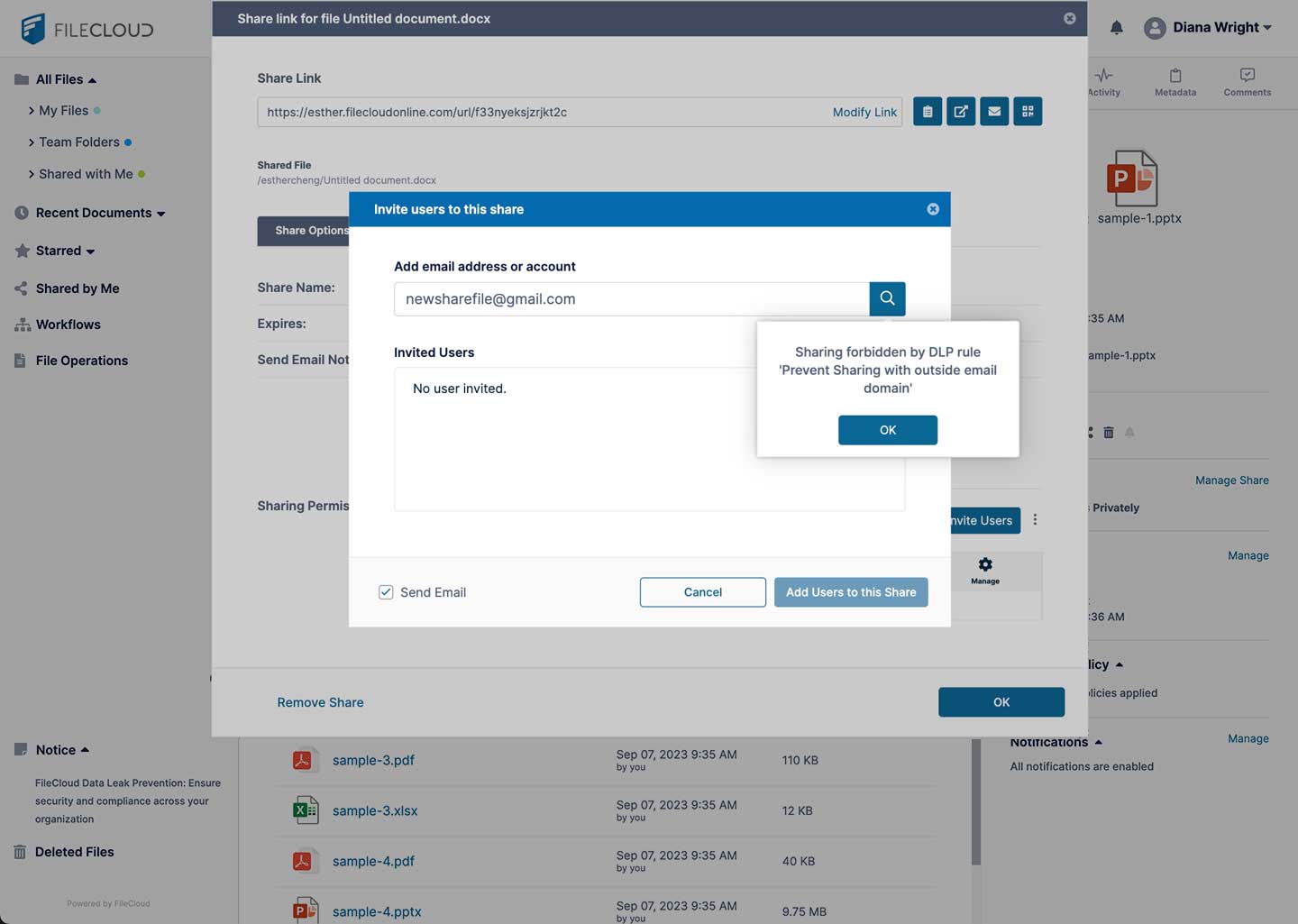
FileCloud Smart DLP sharing blocked

Data Protection, Controlled Access, Protected After Distribution

FileCloud Digital Rights Management (DRM) provides additional controls for sensitive documents after they are shared. Administrators and content owners can restrict actions such as downloading, copying, printing, and screen capture where supported, as well as revoke access when it is no longer required.

Access limits and controlled viewing options give organizations greater control over how recipients interact with sensitive content. These capabilities complement encryption, DLP, and access policies when information must be shared outside the organization.

How to Achieve Data Protection in the Cloud with FileCloud

Effective cloud data protection requires organizations to control access to sensitive information, preserve data integrity, and maintain availability when information is needed.

FileCloud supports these objectives through security, governance, monitoring, and resilience capabilities that can be applied across cloud and hybrid environments, including encryption, access controls, DLP, and DRM.

Integrity with File Analytics and Reports

Maintaining data integrity requires visibility into how information is accessed, modified, and shared. FileCloud provides audit logs, analytics, and reports that help administrators review user activity, file usage, sharing behavior, and other events across the environment.

These insights can support security investigations, compliance reviews, and ongoing policy management. Administrators can use activity data to evaluate whether existing DLP, sharing, and governance policies remain appropriate as business requirements change.

FileCloud comprehensive audit logs

Availability, Recovery, and Resilience

Cloud data protection also requires organizations to maintain access to important information and recover from accidental deletion, disruption, or data loss. FileCloud supports file versioning, deleted-file recovery, and endpoint backup to help users restore files when needed.

With FileCloud Online, FileCloud manages the underlying SaaS infrastructure while customers retain access to file-level protection and recovery capabilities. With FileCloud Server, organizations can incorporate the platform into their own backup, high-availability, and disaster-recovery architecture, whether deployed on-premises, in a private cloud, or as part of a hybrid environment.

Explore FileCloud Deployment Options →

Frequently Asked Questions (FAQs)

What is cloud data protection?

Cloud data protection is the combination of security, governance, access control, monitoring, and recovery measures used to protect data stored or shared through cloud environments. Effective protection helps prevent unauthorized access, data leakage, accidental loss, and misuse while maintaining availability for authorized users.

How does FileCloud support cloud data protection?

FileCloud supports cloud data protection with encryption, granular permissions, multi-factor authentication, DLP, content classification, audit logs, retention controls, file versioning, and recovery capabilities. These controls help organizations protect sensitive information across cloud, hybrid, and self-hosted environments.

What is the difference between FileCloud Online and FileCloud Server for cloud data protection?

FileCloud Online is a SaaS offering in which FileCloud manages the underlying cloud infrastructure. FileCloud Server is self-hosted and can be deployed on-premises, in a private cloud, or in a hybrid environment, giving organizations greater control over infrastructure, storage, backup, and deployment architecture.

Does FileCloud support FIPS 140-3?

Yes. FileCloud supports FIPS 140-3 through FIPS mode on supported deployments. FIPS mode requires the appropriate FileCloud license, configuration, and supported FIPS-enabled operating system; it should not be assumed solely from the deployment model.

How does FileCloud help prevent sensitive data from being shared improperly?

FileCloud combines Smart DLP, Smart Content Classification, granular permissions, secure sharing controls, DRM, and audit logging to help organizations identify sensitive information and restrict inappropriate access or sharing. Administrators can apply policies based on users, groups, metadata, locations, domains, and other conditions.

Can FileCloud support regulatory and compliance requirements?

FileCloud provides security and governance capabilities that can support requirements associated with frameworks and regulations such as HIPAA, GDPR, ITAR, CMMC, NIST 800-171, and FIPS 140-3 on supported deployments. Organizations are responsible for configuring and operating their environment according to their specific compliance obligations.

Worldwide

FileCloud
CodeLathe Technologies Inc.
dba FileCloud
125 Park Avenue FL 25
New York, NY 10017-5550

Europe

FileCloud Technologies Limited
Ducart Suite,
Castletroy Park Commercial Centre, Castletroy,
Limerick, Ireland

Middle East

FileCloud KSA
Building 6847,
Al Olaya Street,
Al Olaya District,
Riyadh 12381, Saudi Arabia


Copyright © FileCloud. All Rights Reserved.
You selected

FileCloud Server

A self-hosted FileCloud trial requires:
  • a Windows or Linux server with storage
  • a valid SSL certificate
  • an appropriate network configuration
  • system administration knowledge

If you prefer to evaluate FileCloud without installation, we recommend using our Online Trial.