Cloud Security Compliance with FileCloud

Ensuring Cloud Security Compliance: Protecting Your Data with Industry Standards & Regulations

Get Free Trial
Client Logo
Client Logo
Client Logo
Client Logo
Client Logo

Leverage the cloud for secure file sharing and content collaboration while complying with cloud security requirements.

Powerful File Sharing

Experience seamless and secure file sharing with granular permissions, ensuring your data remains protected while enhancing collaboration across your organization.

Hyper-Secure Infrastructure

Benefit from military-grade encryption, advanced threat protection, and automatic backups to safeguard your sensitive information at all times.

Built-in Compliance Support

Meet complex industry and government regulations with ease, including GDPR, HIPAA, and SOC 2, to maintain data integrity and avoid penalties.

Gartner Per Insights Logo 2018
Gartner Per Insights Logo 2019
Gartner Per Insights Logo 2020
Gartner Per Insights Logo 2021
Gartner Per Insights Logo 2022

FileCloud has received the Gartner Peer Insights Customers’ Choice Distinction for the fifth consecutive time!

92% of our customers would recommend us to a friend.

Rating Stars Image 4.6

Cloud Security Compliance

Cloud security compliance has become a paramount concern for enterprises, especially those relying on file sharing and secure content collaboration. Cloud security compliance refers to the adherence to laws, regulations, and standards designed to protect sensitive data stored and processed in cloud environments.

As organizations leverage cloud technologies to facilitate operations, they must simultaneously implement robust cybersecurity mechanisms to protect against data breaches and threats while remaining compliant with complex industry and government regulations.

Particularly for organizations in the file sharing and secure content collaboration space, compliance is more than a checkbox—it’s a fundamental aspect of trust and security. Ensuring compliance with standards like GDPR, HIPAA, and SOC 2 is crucial to maintaining the integrity of shared data, mitigating risks, and avoiding hefty fines.

The Importance of Compliance within Cloud Solutions

As enterprises increasingly adopt cloud computing solutions, the need for cloud file sharing that aligns with security compliance standards has never been more critical. Cloud solutions that support security compliance offer several strategic benefits:

  • Data Protection: Ensures sensitive information is safeguarded against unauthorized access and breaches.
  • Legal Adherence: Helps organizations meet regulatory requirements and avoid costly penalties.
  • Trust Building: Demonstrates commitment to data security, enhancing customer and partner confidence.
  • Risk Mitigation: Reduces the likelihood of data breaches and associated reputational damage.
  • Operational Efficiency: Streamlines compliance processes, reducing the burden on IT and security teams.

By meeting cloud security compliance requirements, organizations and enterprises can develop a secure and resilient cybersecurity posture with the power to meet emerging threats and changing regulatory landscapes.

FileCloud Helps Enterprises Achieve Cloud Security Compliance

FileCloud helps enterprises achieve robust cloud security compliance. Whether it is deployed on in a private cloud or hosted by us, FileCloud provides clients with a comprehensive, hyper-secure enterprise file sharing and sync (EFSS) solution.
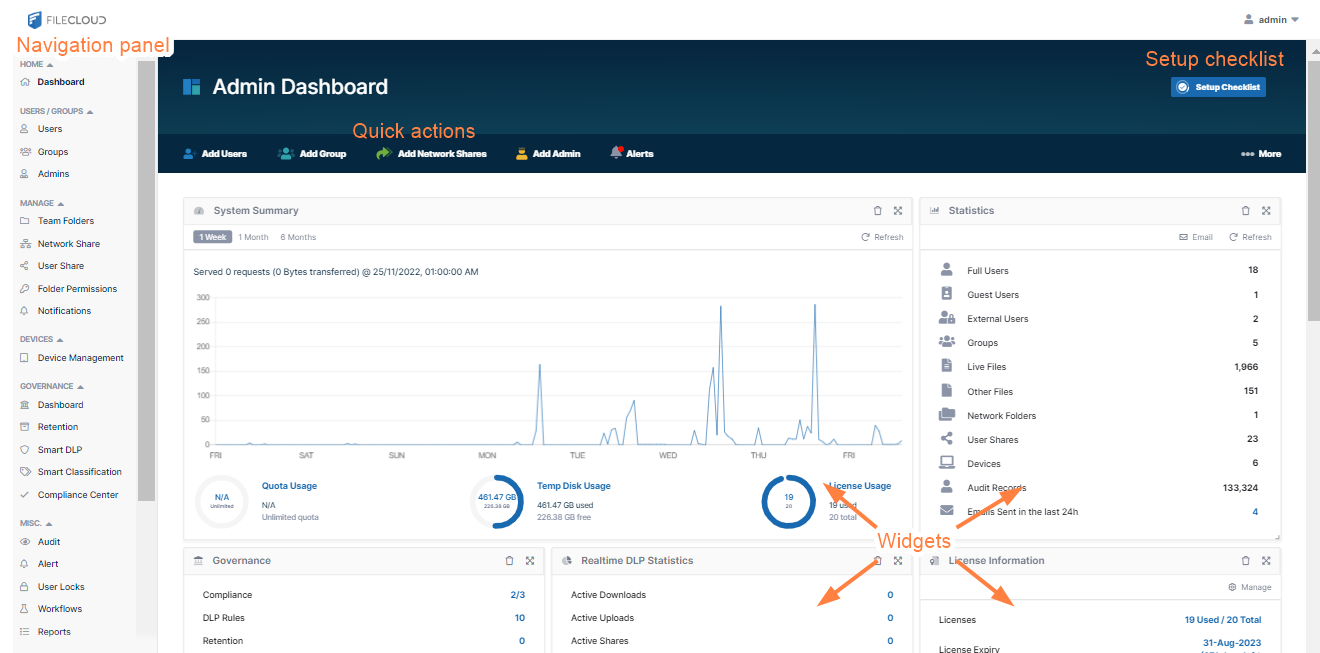
FileCloud Admin Dashboard

8 Ways FileCloud’s EFSS Solution Empowers Enterprises with Cloud Security Compliance

As part of the interface, FileCloud provides a robust set of tools and features that align with cloud security compliance best practices, making it easier for organizations to maintain a secure and compliant cloud environment.

  • Implement a Cloud Compliance Framework:
    Establish a structured approach to managing compliance across all cloud services through the FileCloud admin portal.
  • Conduct Regular Risk Assessments:
    Identify and address potential vulnerabilities in your cloud infrastructure through the governance dashboard, admin notifications, and Compliance Center.
  • Encrypt Data:
    Strong encryption in FileCloud protects data both at rest and in transit.
  • Implement Access Controls:
    Admins can enforce multi-factor authentication and role-based access control to protect sensitive data.
  • Maintain Audit Trails:
    FileCloud tracks all file and user activity in detailed and unchangeable audit logs.
  • Use Automation Tools:
    Admins and users alike can leverage workflow automation in FileCloud to streamline compliance processes and reduce human error.
  • Implement Data Loss Prevention (DLP) Strategies:
    Smart DLP in FileCloud’s Governance Dashboard helps prevent unauthorized data exfiltration automatically, based on rules set by admins.
  • Train Employees:
    FileCloud offers robust documentation and superior customer support. For advanced configurations, clients can even opt for direct training through FileCloud Professional Services.
Compliance Center Dashboard

Frequently Asked Questions (FAQs)

What are key cloud security compliance requirements?

Key cloud security compliance requirements include data protection, access control, encryption, incident response planning, regular security assessments, and audit trails (though requirements may vary depending on the industry and applicable regulations). Generally, requirements focus on ensuring confidentiality, integrity, and availability of data in cloud environments.

What is security compliance in the cloud?

Security compliance in the cloud refers to the adherence to laws, regulations, and industry standards designed to protect sensitive data stored and processed in cloud environments. It involves implementing security controls, policies, and procedures to ensure data privacy, integrity, and availability.

How do you ensure cloud compliance?

Ensuring cloud compliance involves implementing a comprehensive compliance framework, conducting regular risk assessments, encrypting data, implementing strong access controls, maintaining detailed audit logs, and providing employee training. It also requires choosing cloud service providers that offer robust security features and compliance certifications.

What are the challenges in achieving cloud security compliance?

Challenges include keeping up with evolving regulations, managing data sovereignty issues, addressing third-party risks, maintaining data visibility across cloud environments, implementing consistent security controls, and balancing compliance requirements with business needs and user experience.

How does cloud compliance differ from traditional IT compliance?

Cloud compliance differs from traditional IT compliance in several ways: it often involves shared responsibility between the organization and the cloud provider, requires consideration of data sovereignty issues, and needs to address the dynamic nature of cloud environments and rapidly evolving cybersecurity regulations.

What are cloud security guidelines?

Cloud security guidelines are best practices and recommendations for securing cloud environments. They typically cover areas such as data encryption, access management, network security, incident response, and compliance monitoring. Organizations like NIST, CSA, and ISO provide widely recognized guidelines that help organizations address technical and operational aspects of cloud security.

Worldwide

FileCloud
CodeLathe Technologies Inc.
dba FileCloud
125 Park Avenue FL 25
New York, NY 10017-5550

Fax: +1 (866) 824-9584

Europe

FileCloud Technologies Limited
Ducart Suite,
Castletroy Park Commercial Centre, Castletroy,
Limerick, Ireland


Copyright © FileCloud. All Rights Reserved.

Please select your country

SUBMIT